


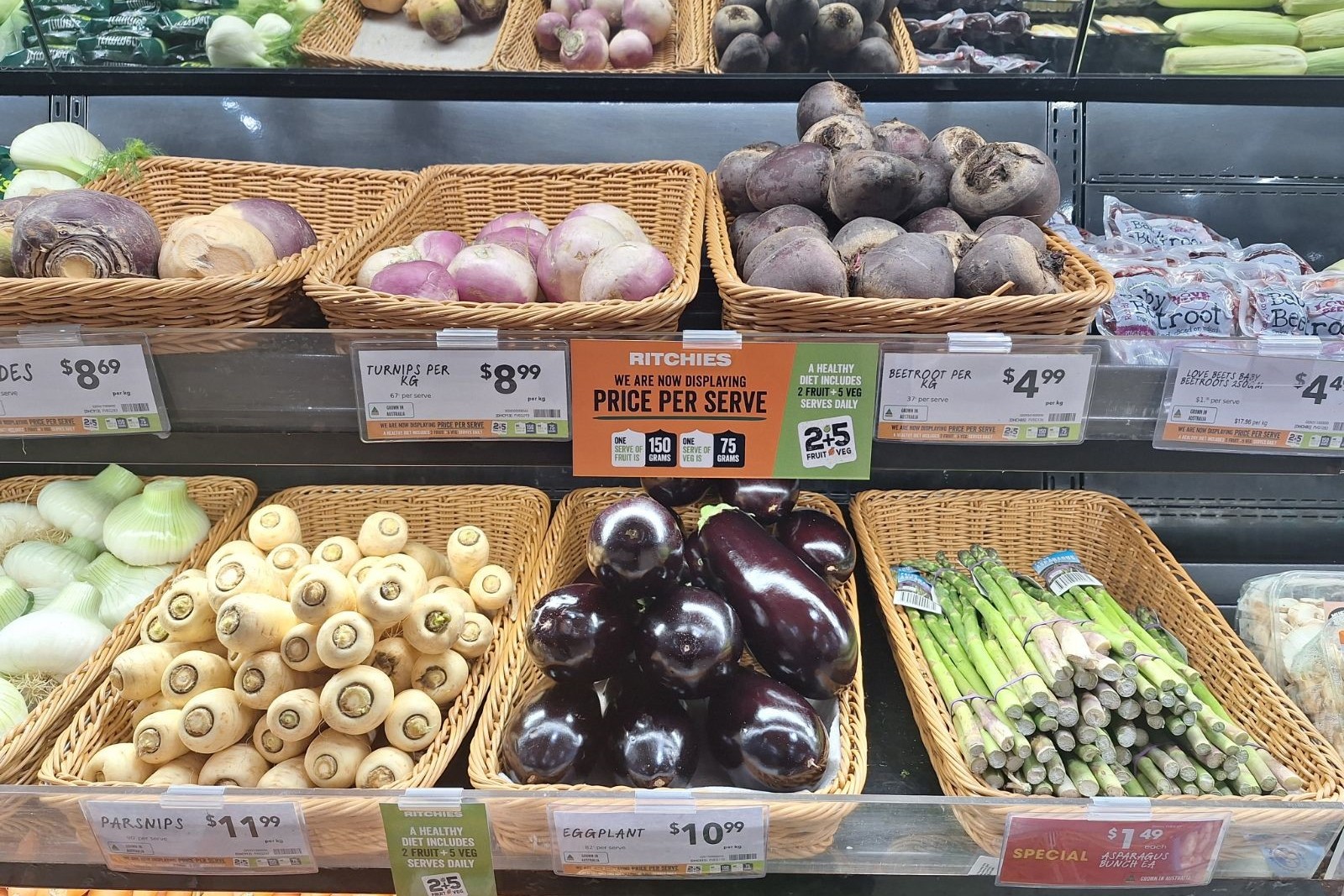
A retail initiative developed by Monash University and Deakin University researchers in partnership with Ritchies has prompted shoppers to buy more vegetables by using ‘nutritional serve pricing’.
Most Australians don’t currently meet the recommended daily intake for vegetables. The latest Australian Bureau of Statistics data indicates that only 6.5% of Australian adults meet the recommended intake for vegetables.
To help address this gap, the researchers introduced an initiative called ‘nutritional serve pricing’. This tool allows supermarkets to display per-serve prices alongside the standard per-kilogram pricing for vegetables. The ‘serving’ size is calculated based on a 75g nutritional serve, in line with Australian Dietary Guidelines.
For example, if carrots are priced at $2.99 per kilogram, under the nutritional serve pricing initiative, the supermarket ticket also shows that one serve costs 22¢. This approach shows the real cost of a typical nutritional serve, helping shoppers see that vegetables are more affordable than they might think.
The new approach was implemented across more than 70 Ritchies stores in March 2024.
Findings
The researchers analysed 850 consecutive days of de-identified loyalty card holder data to compare vegetable and fruit purchases before and after the launch of the initiative.
Released today (26 November), the ‘National evaluation of nutritional serve pricing’ report showed on an individual level the initiative helped to increase the average daily vegetable purchases by more than 60g among all loyalty card shoppers. On a store level, the initiative significantly increased daily vegetable purchase volumes by 7.5kg.
Analyses were based on 56 stores that traded across this full period, thereby controlling for variations in sales volumes due to factors such as store openings and renovations.
Consumer psychology expert and research lead for this initiative, Associate Professor Fiona Newton from Monash Business School, says that while the findings reflect aggregated purchasing patterns rather than the individual consumption of vegetables, they show a clear shift in behaviour following the introduction of per serve pricing.
“Vegetable consumption in Australia remains far below recommended levels, and many families feel that healthier choices are less affordable,” she says.
“By showing the cost of a single nutritional serve, we are giving shoppers a clearer sense of value and a simpler way to assess what fits within their budget.
“This research shows that we can support healthier choices by better framing the everyday cues that shoppers already use in their decision-making.”
Research co-author and Professor of Marketing at Deakin University, Professor Josh Newton, says the partnership with Ritchies created a valuable opportunity to study consumer behaviour in a natural retail setting.
“These findings offer retailers, health organisations and policymakers a practical and cost-effective tool for boosting healthy purchasing habits and potentially improving population diets,” he says.
“The gains we observed occurred without any promotional activity, which highlights how powerful clear price communication can be.”
The supermarket’s role
Ritchies CEO Fred Harrison says the new pricing approach shows the influence supermarkets can have in promoting healthy food choices.
“At Ritchies, we are proud to partner with world-leading researchers from Monash and Deakin universities to deliver clear evidence that supports healthy options and value for our shoppers,” he says.
“By showing the cost of a single serve, we are making healthy choices simpler and helping families put more fresh produce on the table while keeping value front of mind.
“It’s part of our commitment to helping Australians meet the national recommendation of two serves of fruit and five to six serves of vegetables each day. That’s why we’re making the findings of this important research publicly available.”
Backed by AUSVEG
The national peak body for vegetable growers, AUSVEG, has formally endorsed the retail initiative.
AUSVEG CEO Michael Coote says the results point to a promising opportunity for growers and retailers.
“The success of the nutritional per serve pricing initiative with Monash University, Deakin University and Ritchies IGA demonstrates the power of using research to get Aussies to see the great value of adding more vegetables to their shopping baskets,” he says.
“AUSVEG is proud to officially endorse and share the findings of this important white paper with our Board, vegetable growers, industry and retail partners as part of our commitment to increasing national vegetable consumption through the Plus One Serve program.”
Managing Director of Plus One Serve, Justine Coates, says the new approach provides consumers with a clearer way to understand both cost and dietary guidance.
“Nutritional-per-serve pricing gives consumers a clear and meaningful way to understand both value and recommended dietary intake through a practical, scalable tool that makes choosing vegetables easier every day,” she says.
“It’s an evidence-based approach that we encourage retailers to implement as an important part of achieving our Plus One Serve by 2030 goal – delivering healthier communities, supporting Aussie growers, and building a more secure food system.”
What’s next?
Looking ahead, the Monash and Deakin researchers are exploring opportunities to replicate and adapt the approach across other retail settings.
Monash’s Ms Newton says the broader potential of improving vegetable purchasing at the population level is significant.
“Data from AUSVEG indicates that if every Australian were to purchase and consume one extra serve of vegetables per day, the projected national benefits include $1.38 billion dollars in healthcare cost savings, $3.30 billion dollars in supply chain benefits and 12,841 new jobs supported across production and retail,” she says.
Get Retail Insights That Matter
Access exclusive grocery and retail industry updates. Join Australia’s top retail newsletter today.

