


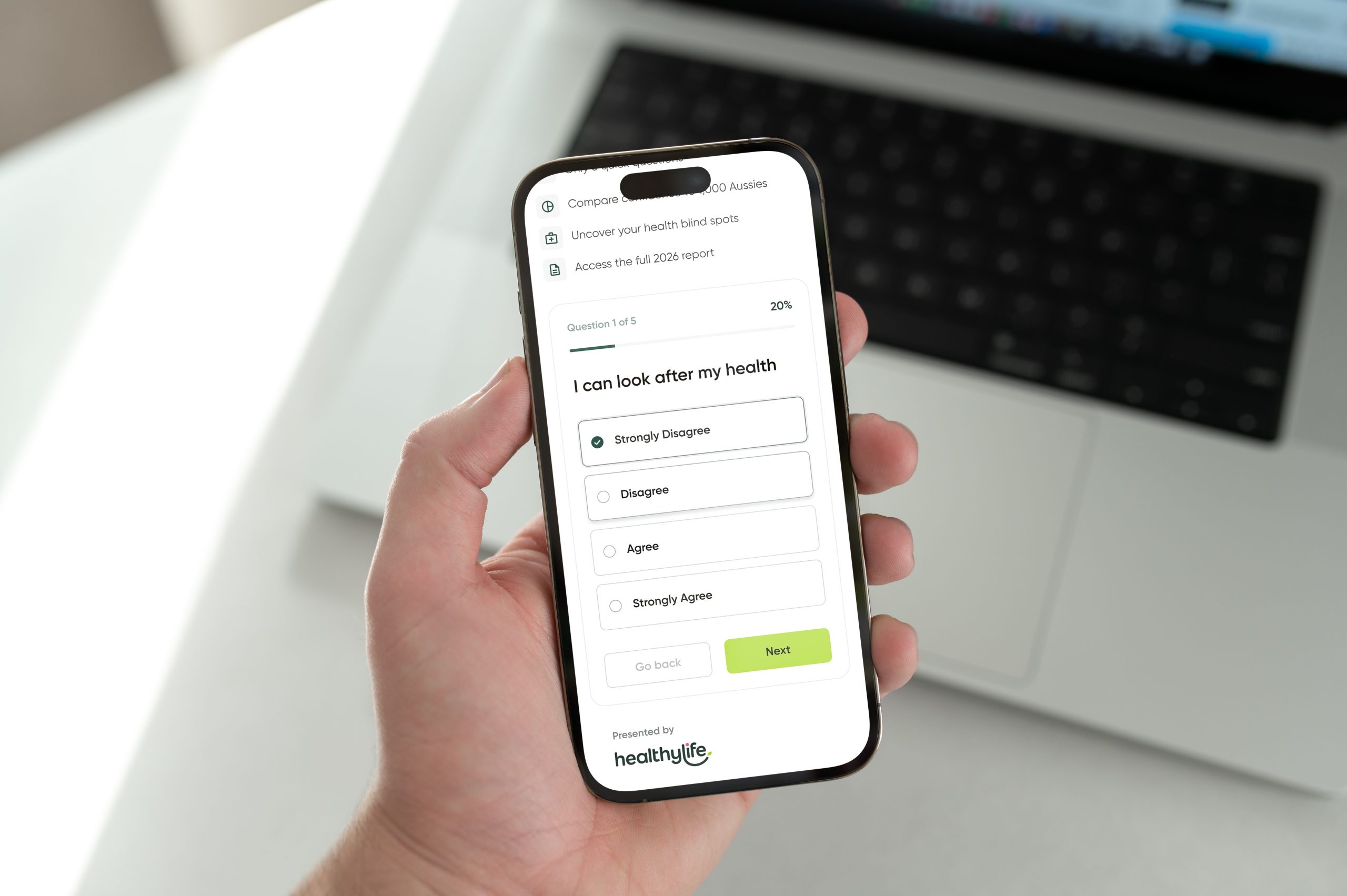
Australians say they are confident about managing their health, but a new report from Healthylife shows otherwise, revealing a significant gap between perception and reality.
“It is a common misconception that achieving good health is simply a matter of personal willpower,” says Healthylife Chief Health Officer and Accredited Practising Dietitian Simone Austin.
“Our data reveals a national ‘blind spot,’ where overconfidence, or inaccurate perceptions, a type of cognitive bias, often known as the Dunning-Kruger effect, can be masking the health challenges the nation truly faces.”
The evidence of overconfidence
The inaugural Healthylife National Health Confidence Survey of over 1,000 respondents, found that as a nation we are confident in our ability to look after our health, with a mean National Health Confidence Score of 75 out of 100. This uses five key questions based on social and environmental influences on our health to calculate the score.
The report highlights that this high level of self-assurance often clashes with rising chronic disease rates and the reality that many of us are not adopting the healthy habits that we perceive we can:
- Medication & Supplements: 95% of Australians agree or strongly agree they know how to use medications appropriately, yet behaviour often falls short, such as patients stopping medications for chronic conditions within the first year.
- Supplement Risks: 85% of people agree or strongly agree they can choose supplements suited to their health, yet many lack an understanding of the ingredients and risks, such as Vitamin B6 overconsumption causing peripheral neuropathy.
- Dietary Choices: Despite 87% of people agreeing or strongly agreeing their environments support them to eat healthy, our data on Australians’ food purchases for at-home eating shows nearly double the number of discretionary food serves purchased (5.7 per day) compared to vegetables (2.9 per day). These purchasing habits are not in line with the Australian Dietary Guidelines and show minimal shifts over 4 years.
The digital shift
The report also reveals a growing reliance on digital tools, with 46% of people having moderate or high trust in health information received from AI.
Younger people tend to be more trusting of AI – 62% of those aged 25–44 have moderate or high trust in AI for health information, more than double the 27% moderate or high trust level found in those aged 65 and over.
Geographic location also influences this shift, with 49% of metropolitan residents having moderate or high trust in AI for health advice compared to 37% in regional areas.
This growing reliance on digital tools poses risks as 93% of Australians agree or strongly agree that the health information they have is correct, despite a high prevalence of digital misinformation.
“Even though AI is a powerful tool for health information, there is a significant amount of misinformation, so to bridge this gap, high confidence must be built on accurate self-awareness and credible information from trusted health professionals,” said Ms Austin.
To download the report and to take the survey, visit healthylife.com.au/health-report-2026.

